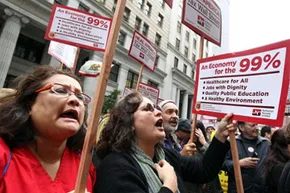
“We are the 99%!”
It’s a slogan that still stings when I hear it. The Occupy Wall Street movement used the term to denounce the huge gap between the super-rich and everyone else. But where does this number come from? Is it true that the top 1% control a third of the country’s wealth?
The answer is yes. But before the statistics can make sense, you need to understand the difference between income and wealth.
Income and wealth: key differences
Most people confuse their income with their assets. they are not the same.
Income is cash flow. This is the amount of money that goes into your bank account during the year from your job, side hustle.
Wealth (or net worth) is the cumulative value of assets minus liabilities.
Wealths include:
– Cash in the bank
– Investments (shares, bonds, CDs)
– Retirement accounts (401(k), IRA)
– Real estate
– Tangible items such as jewelry, artwork, collectibles, etc.
Debts subtract from the total:
– Mortgage
– Student loans
– Credit card balance
Why is this distinction important? Because inequality can look very different depending on which metric you use.
Income differences are huge. The gap between the rich and the poor is growing.
According to a study by economists Thomas Piketty and Emmanuel Saez, in 2008 the top 1 percent earned 17.67 percent of total U.S. income. Less than a fifth. To be in the top 1 percent in 2011, you needed just over $500,000 in cash income.
That’s a lot of money. But it’s not a real disparity.
Wealth inequality is far more extreme. According to an analysis of Federal Reserve data by the Economic Policy Institute, the top 1% control 35.6% of the nation’s total wealth. That’s more than a third.
Even starker, the top 10% control 75% of the wealth. The remaining 90% fighting over the other quarter.
“At the height of the bubble in 2007, half of Americans did not own stocks.”
Why does this gap exist?
It’s not just luck. This is math.
It’s easy to get rich when you already have money. Wealthy people can save and invest a large part of their income. Low-income households spend most of their paychecks on immediate living expenses, such as rent, food, utilities, child care, and debt repayment.
There is nothing left to invest in the stock market. There is nothing left to feed a 401(k).
The Economic Policy Institute points to chilling statistic from 2007. At the height of the housing and economic bubble, half of Americans did not own stocks. They were completely shut out of the main engine of wealth creation in America.
Tax policy widens the divide
Government policy also has its own role.
Income from capital income (profits from the sale of shares and other investments) is taxed at a lower tax rate than ordinary income. Currently, this tax rate is 15 percent compared to the higher marginal tax rate.
The more money you earn from your salary, the more you pay in taxes. The more money you earn from your investments, the more money you keep in your pocket. This system is useful for people who have capital.
Is this new?
The gap between rich and poor is not a new phenomenon. This is a structural feature of the US economy.
The Economic Policy Institute states that since 1962, the gap between the rich and the poor has grown by only 2.2 percentage points. The wealthy are always disproportionately rich.
What has changed dramatically is the rate of income growth.
A 2011 report by the Congressional Budget Office highlighted this gap. Between 1979 and 2007, the income of the top 1% grew by 275%. Meanwhile, income growth for the middle class (21st to 80th percentile) was less than 40%.
This is not convergence. This widens the divide.
Understanding these numbers is not just politics. This is very practical. If you want to close the gap, we need to do more than just make money. You have to build assets. You need to understand how capital gains work. You have to understand that saving for a rainy day is different from investing in a new life.
The 99 percent are loud. But the numbers show that the 1% are sitting on a mountain.