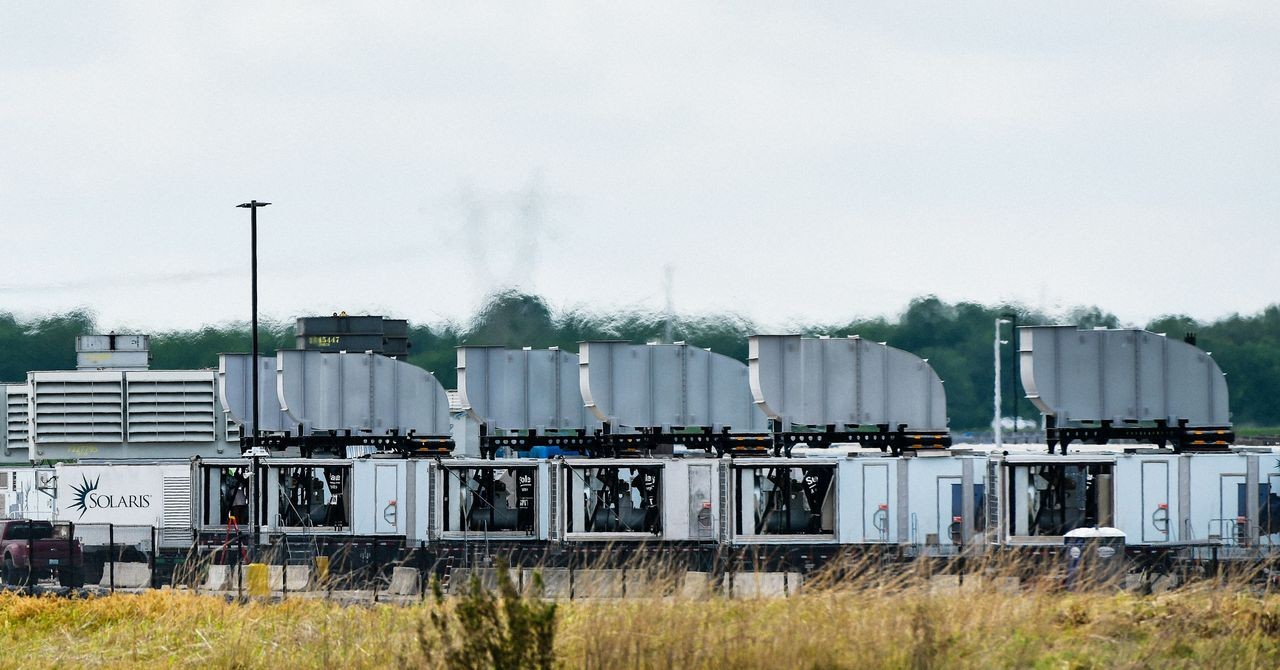
Elon Musk’s artificial intelligence company, xAI, has significantly expanded its energy infrastructure in Mississippi despite facing active legal challenges over environmental compliance. According to internal documents and regulatory emails, the company added 19 new natural gas turbines to its Southaven data center campus—dubbed Colossus 2—between late March and early May.
This expansion brings the total number of operating turbines at the site to 46, adding more than 500 megawatts of power generation capacity. The installation occurred while a lawsuit was pending, alleging that xAI was violating the Clean Air Act by operating turbines without proper permits.
Escalating Legal and Environmental Concerns
The additions were uncovered through a public records request by the Southern Environmental Law Center (SELC). Emails exchanged between the Mississippi Department of Environmental Quality (MDEQ) and Trinity Consultants, a consulting firm, detail the installation of these “portable” units.
The legal tension has intensified since April, when the NAACP, SELC, and Earthjustice filed a lawsuit against xAI. The initial complaint alleged that the company was operating 27 turbines as a de facto “personal power plant” without necessary air permits. However, drone surveillance and subsequent document reviews revealed that the situation was more complex than initially reported.
- Initial Allegation: The lawsuit cited 27 unpermitted turbines.
- New Findings: Investigations revealed 19 additional turbines were installed after the lawsuit began.
- Total Capacity: The 27 original turbines represented approximately 495 megawatts—enough to power 400,000 homes. The new additions add over 200 megawatts of capacity, with eight of the 19 new units installed after the legal filing.
Ben Grillot, a lawyer for the SELC, described the rapid expansion as “absolutely crazy,” noting that only after reviewing MDEQ emails did his team realize the full scale of the unauthorized installations.
The “Portable” Loophole and Regulatory Response
A central point of contention is the classification of these turbines. Regulators in both Tennessee and Mississippi have indicated that because xAI’s turbines are not permanently fixed to the ground, they may qualify as “portable” or “temporary” under the Clean Air Act. This classification theoretically allows the company to operate them for up to a year without standard stationary source permits.
However, this technicality has drawn sharp criticism from environmental advocates and local communities.
“As indicated by the facility, all portable/temporary turbines are equipped with control technology to minimize emissions,” said Jan Schaefer, an MDEQ spokesperson. “MDEQ is evaluating the situation and will make the facility aware as to when it can no longer bring additional portable/temporary turbines on-site.”
Despite this, Schaefer confirmed that the 46 turbines currently operating at the Southaven site are not covered by the air permit granted in March, which was limited to 41 units. Furthermore, drone footage obtained by news outlet Floodlight suggests that multiple turbines were already running in the weeks before that permit was issued.
Community Impact and Strategic Implications
The expansion raises significant questions about environmental justice. The original xAI site, Colossus 1, is located in Boxtown, Memphis—a historically Black neighborhood that has long struggled with poor air quality. The new Southaven site faces similar scrutiny, with critics arguing that the burden of AI’s energy hunger is being disproportionately placed on marginalized communities.
Abre’ Conner, the NAACP’s director of environmental and climate justice, stated:
“Any company that disregards the obvious environmental and health concerns of Black communities to supposedly power a future that will help us all is sending a clear message about who it intends to serve in that future.”
The stakes are high for xAI’s operations. Last week, the NAACP filed for an emergency injunction to shut down the Colossus 2 turbines. In response, xAI argued that the data centers are critical infrastructure. The company claimed that without these temporary power generators, the facilities—which support AI tools used by the U.S. government and millions of users globally—would face immediate shutdown.
The strategic importance of these sites was underscored by recent developments:
1. Anthropic Partnership: Anthropic announced an agreement to utilize all computing resources at Colossus 1.
2. SpaceX Integration: Elon Musk stated on X that training for “SpaceXAI”—the result of the merger between SpaceX and xAI—has already moved to Colossus 2.
Conclusion
xAI’s decision to install 19 additional gas turbines while under legal scrutiny highlights the growing tension between the rapid scaling of artificial intelligence infrastructure and existing environmental regulations. As companies race to build the computing power necessary for next-generation AI, the definition of “temporary” energy solutions remains a contentious legal and ethical battleground, particularly in communities already vulnerable to pollution.