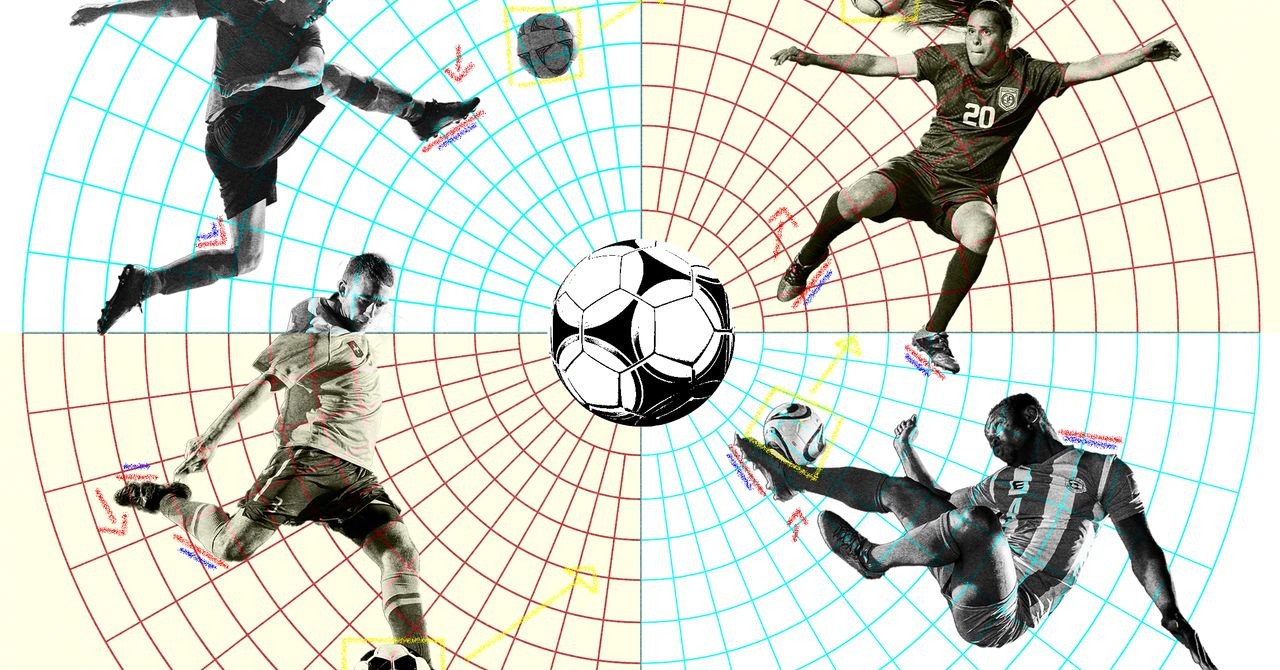
Soccer remains the most stubborn adversary of modern sports analytics. While baseball has been successfully reduced to spreadsheets and basketball to efficiency metrics, soccer defies orderly examination by design. It is not a linear equation but a fluid, chaotic ecosystem where the value of an action depends entirely on the context of the moment.
For data scientists and analysts, this resistance is both a challenge and a fascination. The game’s complexity requires not just more data, but smarter questions. As researchers have discovered, understanding soccer means accepting that there is no single “correct” way to play, only a series of trade-offs where every tactical advantage comes with a corresponding risk.
The Illusion of Order in Chaos
The core difficulty of soccer analytics lies in the game’s low-scoring nature and high variability. In baseball, a swing is an isolated event with clear outcomes. In soccer, a player’s movement without the ball can be as impactful as a goal, yet it is far harder to quantify.
Luke Bornn, a data scientist who previously analyzed helicopter blade stress and herd movement patterns, recognized that soccer shares characteristics with these complex physical systems. He and his collaborator, Javier Fernández, developed statistical techniques to measure “space creation” —how players manipulate opponents’ positioning without touching the ball.
Their research revealed a counterintuitive truth about one of the game’s greatest legends: Lionel Messi.
“Messi does this very effectively, placing him near the top of players in terms of space gained during the whole match, despite the lack of active gain.”
Contrary to the popular belief that Messi’s slow saunters were signs of laziness or energy conservation, data shows these movements are highly calculated. By walking through specific zones, Messi forces defenders to shift, subtly distorting the “geography” of the pitch and opening lanes for attack. He achieves more on a stroll than most players do with a sprint, proving that static presence can be a dynamic weapon.
The Markov Chain Revolution
If Bornn focuses on spatial manipulation, Sarah Rudd pioneered the statistical framework for understanding probability and decision-making in soccer.
Rudd, who began her career analyzing low-definition broadcasts of South American matches, realized that traditional stats like goals and assists failed to capture the value of individual actions. To solve this, she applied Markov chains, a mathematical model originally developed by Russian mathematician Andrey Markov in 1906.
Markov chains operate on the principle that future probabilities depend on the current state of the system, rather than independent random events.
* In a roulette wheel, each spin is independent.
* In Monopoly, where you land depends entirely on where you started.
* In soccer, the value of a pass depends on the player’s location, possession status, and defensive pressure at that exact moment.
Rudd’s 2011 paper, “A Framework for Tactical Analysis and Individual Offensive Production Assessment in Soccer Using Markov Chains,” divided the pitch into 39 distinct “states.” This allowed analysts to calculate the likelihood of scoring from any given position, effectively quantifying the “danger” of a pass or the “stupidity” of a long shot. This work not only won her a competition but also landed her a role at Arsenal, where she helped introduce advanced analytics to the Premier League.
The Problem with Simple Answers
Despite these technological leaps, soccer remains resistant to definitive solutions. The central tension in modern analytics is the conflict between control and chaos.
Two of the game’s most successful managers represent opposing philosophical extremes:
* Johan Cruyff believed possession was paramount: “A footballer has to have the ball at his feet.”
* José Mourinho argued that possession brings vulnerability: “Whoever has the ball has fear.”
Both approaches have produced champions, proving that there is no single optimal strategy. As Rudd notes, trying to find the perfect tactical balance is like “trying to cover yourself with a blanket that’s too short.” If you press high, you leave space behind. If you sit deep, you concede possession. Analytics can measure the trade-offs, but it cannot dictate the choice.
Furthermore, early analytical models often imposed artificial order on the game. Rudd admits that her early work dividing the pitch into equal grid boxes was a “misguided desperation” for simplicity. Modern data reveals that the pitch is not linear; it is a reactive field where zones of congestion shift based on tactical trends, such as defenses funneling play wide or pressing high.
Conclusion
Soccer analytics has evolved from rudimentary tracking to sophisticated probabilistic modeling, yet the game’s soul remains intact because data cannot replace intuition. The beauty of soccer lies in its ambiguity and the myriad ways teams can win. As the industry matures, the role of the analyst shifts from seeking a “correct” answer to providing a “calm voice of reason” amidst the emotional chaos of competition. Ultimately, soccer defies complete statistical capture because it is, above all, an art form played by humans, not a machine to be optimized.