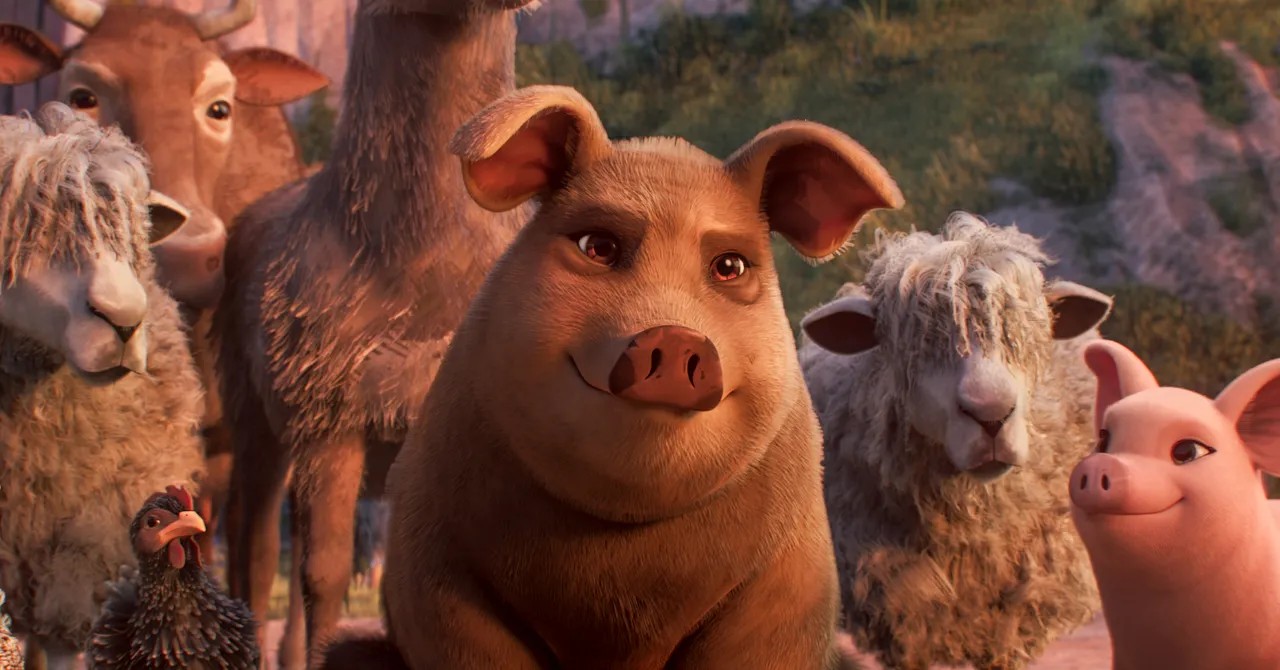
The right-wing backlash against the upcoming animated adaptation of George Orwell’s Animal Farm has devolved into a chaotic display of internal contradiction. Rather than uniting behind a shared interpretation of the classic political satire, influential voices within the MAGA movement are fiercely debating the film’s supposed ideological message. This confusion highlights a broader trend: a declining ability to engage with complex political art without reducing it to simplistic partisan talking points.
A Classic Misunderstood
Published in 1945, Animal Farm remains one of the most enduring critiques of totalitarianism in literature. The story follows barnyard animals who overthrow their human owner to create an egalitarian society, only to see their revolution corrupted by power-hungry pigs who eventually mirror the oppressive behaviors of the humans they replaced.
The core message is not a straightforward endorsement of capitalism, nor is it a simple condemnation of socialism. Instead, Orwell’s work is a universal warning about how the lust for power corrupts morality, regardless of the political system in place. It suggests that ideology, when stripped of ethical constraints, inevitably leads to tyranny.
The Influencer Backlash
The controversy surrounding the new film, directed by Andy Serkis and scheduled for release in May, began when prominent conservative influencers reacted to the trailer. Athlete and influencer Riley Gaines posted a video praising the film’s production value, claiming it perfectly illustrated that “Marxism always has and always will fail.” She included the hashtag #AnimalFarmPartner, leading many to believe she had been paid by Angel Studios, the distributor behind faith-based films like Sound of Freedom.
However, Gaines’ interpretation was quickly rejected by other key figures on the right. Despite her claim that the film condemns Marxism, fellow conservatives accused her of promoting communist ideology.
- Tim Pool, a right-wing podcaster, stated he had turned down a promotion deal with Angel Studios because he viewed the film as “pro communism and anti-capitalism.” He later tweeted that promoting such content was becoming the “new gay for pay.”
- Peachy Keenan, another influencer, dismissed the film as “retarded socialist propaganda.”
This internal conflict reveals a fundamental disconnect. While Gaines saw the film as a critique of Marxism, her ideological allies saw it as an endorsement of it. Both interpretations miss the nuance of Orwell’s original text.
Why the Confusion Matters
The inability of these influencers to agree on the film’s message is not just a trivial dispute over movie reviews; it reflects a significant crisis in media literacy.
In today’s polarized information landscape, there is little room for ambiguity. Complex works of fiction that explore moral gray areas are often forced into binary categories: either “pro-left” or “pro-right.” When a work does not clearly telegraph a single, uncomplicated moral message, it is frequently misread or rejected entirely.
The new adaptation, which adds a greedy human character voiced by Glenn Close to emphasize themes of authoritarianism, may have further complicated this dynamic. Director Andy Serkis described the film as being about “authoritarianism and power corrupting and our response to that.” This theme should theoretically resonate with conservatives concerned about government overreach. Yet, the backlash suggests that many viewers are so focused on identifying political enemies that they overlook the film’s broader critique of power itself.
The Bigger Picture
The chaos surrounding Animal Farm is symptomatic of a wider cultural shift. As political discourse becomes increasingly tribal, the ability to engage with nuanced art and literature diminishes. Instead of grappling with complex ideas, public figures often resort to labeling works as “propaganda” based on superficial cues.
Orwell, who was claimed by both the left and the right during his lifetime, likely would have found this confusion ironic. His work was designed to expose the mechanisms of manipulation and the dangers of blind ideological adherence. The fact that his satire is now being used as a weapon in a culture war—while being misunderstood by those who claim to champion freedom—underscores the very dangers he sought to highlight.
“The tragedy is not that the film is bad, but that its audience is so eager to find a villain that they miss the mirror.”
Conclusion
The MAGA movement’s fractured response to Animal Farm serves as a cautionary tale about the erosion of critical thinking in political discourse. When complex art is reduced to a binary checkmark for partisan loyalty, the deeper truths of the work are lost. This incident illustrates that in an era of rapid information consumption, the ability to interpret nuance is becoming a rare and undervalued skill.